

Reel mowers, explained
How a reel cuts, and how it compares with a rotary mower.
Disclosure: We may earn a commission if you buy through links on this page. It does not change our guidance. Affiliate Disclosure
How a reel cuts
Under the CPSC mower standard, a reel mower turns one or more helical blades about a horizontal axis against a stationary cutter bar or bed knife. Kansas State University (K-State) calls this a scissors or shearing action.
Reel vs rotary
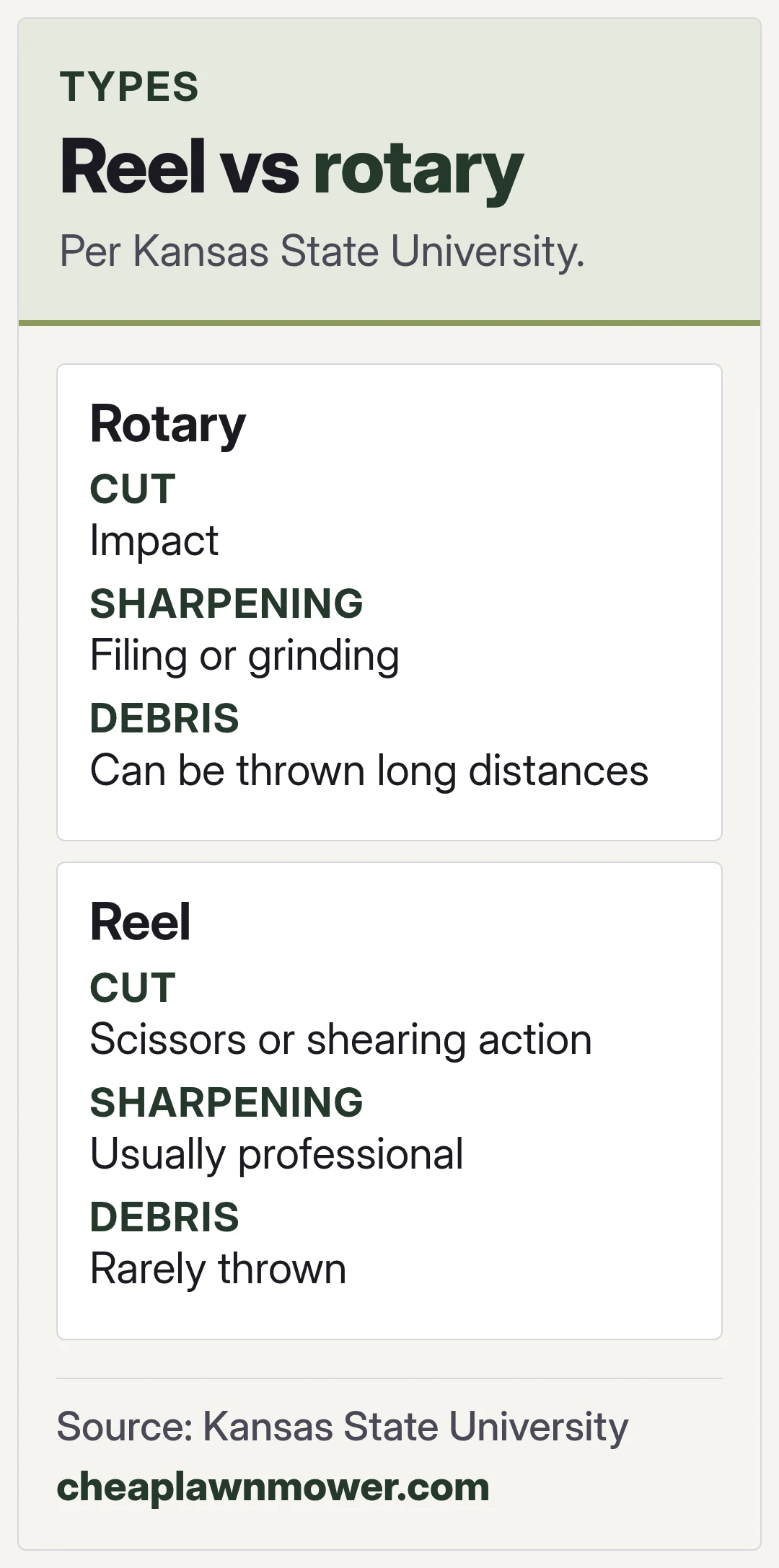
K-State says a rotary mower cuts by impact and is better for heights above 1 inch. It says a reel mower gives excellent quality on short-cut turf when the blades are sharp, but may lay longer grass over instead of cutting it cleanly.
Upkeep
K-State says rotary blades can usually be sharpened by filing or grinding. It says a reel mower usually needs professional adjustment and sharpening.
Blade speed and debris
K-State says rotary blades revolve at high speed and can throw debris long distances. It says reel blades revolve more slowly, and debris is rarely thrown.
Cost, without numbers
K-State says powered reel models can be very expensive, and powered rotary models are usually less expensive. It gives no figures, and neither do we.
Where reels are used
University of Illinois Extension says reel mowers are used on high-quality, low-cut lawns like putting greens, and are not typically used by homeowners.
FAQ
General information only. Read the operator's manual before you mow. Keep children and pets indoors or well away from the area you mow, and never let a child ride on a mower as a passenger. The American Academy of Pediatrics says that, in general, children should be at least 12 years old to operate a walk-behind power mower safely and at least 16 to operate a riding mower safely. Before you clear, adjust, or service the blade area, turn the mower off, wait for the blade to stop, and disconnect the spark plug wire; on a battery or corded electric mower, follow the manual to disconnect its power. Refuel outdoors, only with the engine off and cool. Wear sturdy closed-toe shoes and eye and hearing protection. In an emergency, call 911.


Next: mower types
Rotary, reel, riding, robotic.
