
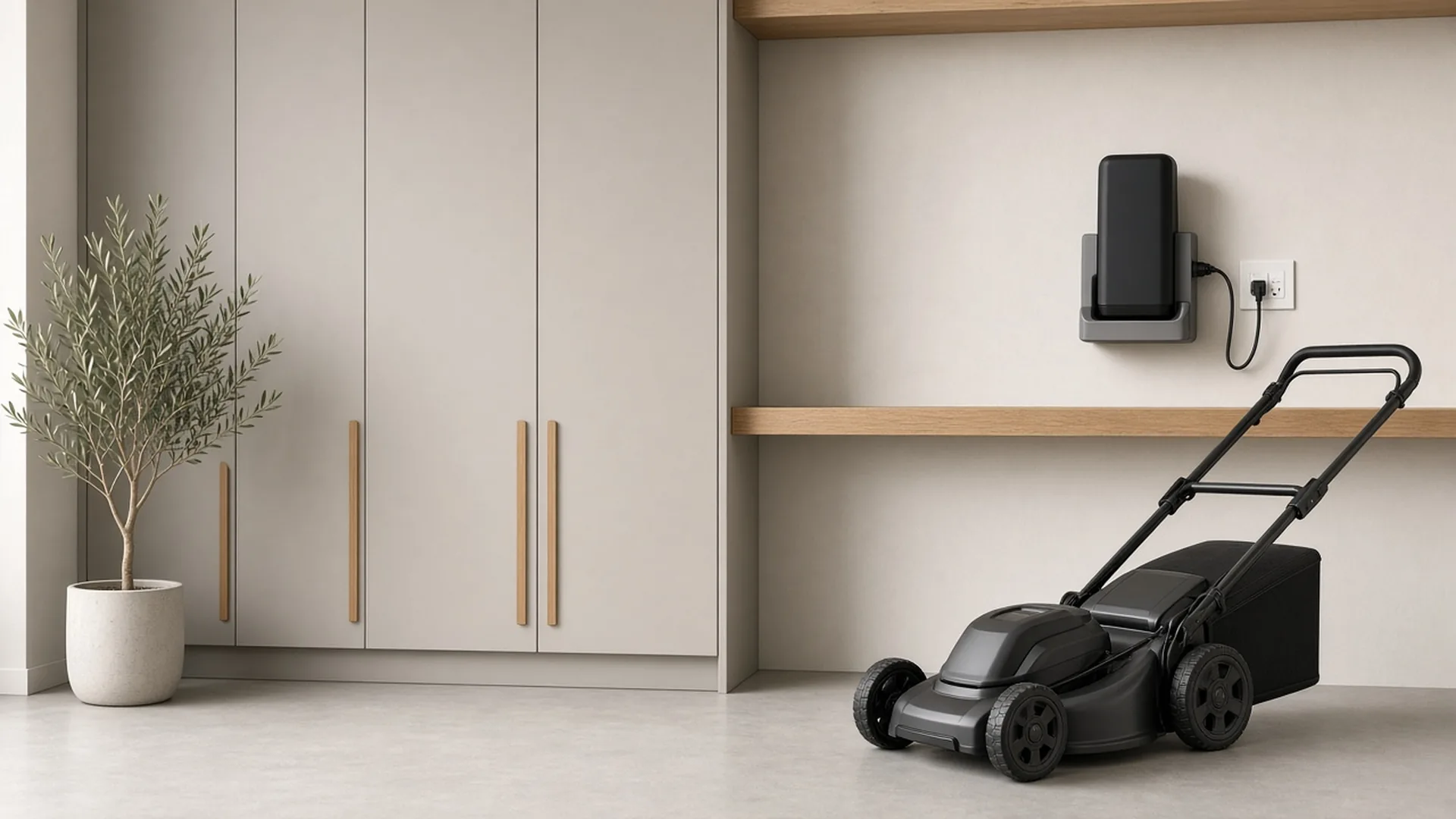
Lawn mower battery charging and storage
What the CPSC, the U.S. Fire Administration, and EPA say about chargers, outlets, warning signs, storage, and disposal.
Disclosure: We may earn a commission if you buy through links on this page. It does not change our guidance. Affiliate Disclosure
A battery mower runs on a rechargeable pack, and a riding mower may have a battery that starts its engine. The U.S. Fire Administration (USFA) says batteries can be a fire danger when people do not follow the product instructions for using, storing, or disposing of them. This guide covers what the CPSC, the USFA, and EPA say about chargers, outlets, warning signs, storage, and disposal. Charging times, storage temperatures, and how much charge to leave in a pack come from your mower's manual. We give none.
What should you check before buying a pack?
The USFA handout on lithium-ion battery safety, written for electronic devices in general, says to check the CPSC site, SaferProducts.gov, for recall information on any product you are considering. It also says to look for the stamp of a Nationally Recognized Testing Laboratory on both the packaging and the product. A recall check uses the model number; our manual and model number guide covers where to find it.
Which charger should you use?
The one that came with the mower, or the one its maker names. The CPSC says that with battery-powered tools, "only use the battery and charger provided by the manufacturer." The USFA says "Always use the charger provided by the manufacturer for the device being charged." Your manual says how long a charge takes and when the pack is full.
Where should the charger be plugged in?
The USFA says "Charging devices should be plugged directly into an outlet and not into extension cords or multiplug adapters." It says not to overload outlets, and that adapters and power strips can overheat. It adds that when in doubt, a licensed electrician can test your circuits.
What are the warning signs?
The USFA says to "Stop using lithium-ion batteries if you notice an odor, change in color, too much heat, change in shape, leaking or odd noises." It says repairs to a lithium-ion battery pack should be done only by a "certified repair facility." If a pack shows one of those signs, stop using it and follow the manual or contact the maker. In an emergency, call 911.
How should you store a battery?
Follow the manual for where to keep the pack between uses and over winter. The USFA says to "Store spare lithium-ion batteries away from anything that can burn." It also says "Don't put lithium-ion batteries in direct sunlight or keep them in hot cars."
What about a riding mower's starting battery?
Some riding mowers have a battery that starts the engine. Its manual covers charging and winter care, and it may say to remove the battery for storage. If the battery is lead-acid, EPA, in its advice on lead-acid batteries such as car batteries, says it "Contains sulfuric acid and lead." It says to "follow all warnings and instructions on the battery" when you handle it. Read the manual before you touch the battery or its cables.
How do you dispose of an old battery?
Not in the trash. For a lead-acid battery, EPA says to "Return lead-acid batteries to a battery retailer or local household hazardous waste collection program". For lithium-ion packs, the USFA says not to put them in the trash or recycling bins, because they can ignite, and to tape over the ends and terminals. EPA says "Lithium-ion batteries and devices containing these batteries should NOT go in household garbage or recycling bins." It says to put each battery in its own plastic bag and to cover its terminals with tape that does not conduct, such as electrical tape. If a lithium-ion pack is damaged, EPA says to ask the battery or device maker how to handle it.
Sources: CPSC, Home Safe Yard Care (PDF); U.S. Fire Administration, Battery Fire Safety; U.S. Fire Administration, Lithium-Ion Battery Safety for Electronic Devices (handout, PDF); EPA, Used Household Batteries; EPA, Used Lithium-Ion Batteries; Ohio State University Extension, Power Lawn Mowers.
FAQ
General information only. Read the operator's manual before you mow. Keep children and pets indoors or well away from the area you mow, and never let a child ride on a mower as a passenger. The American Academy of Pediatrics says that, in general, children should be at least 12 years old to operate a walk-behind power mower safely and at least 16 to operate a riding mower safely. Before you clear, adjust, or service the blade area, turn the mower off, wait for the blade to stop, and disconnect the spark plug wire; on a battery or corded electric mower, follow the manual to disconnect its power. Refuel outdoors, only with the engine off and cool. Wear sturdy closed-toe shoes and eye and hearing protection. In an emergency, call 911.
Storing the whole mower
Fuel, battery, and storage, per the sources.
